
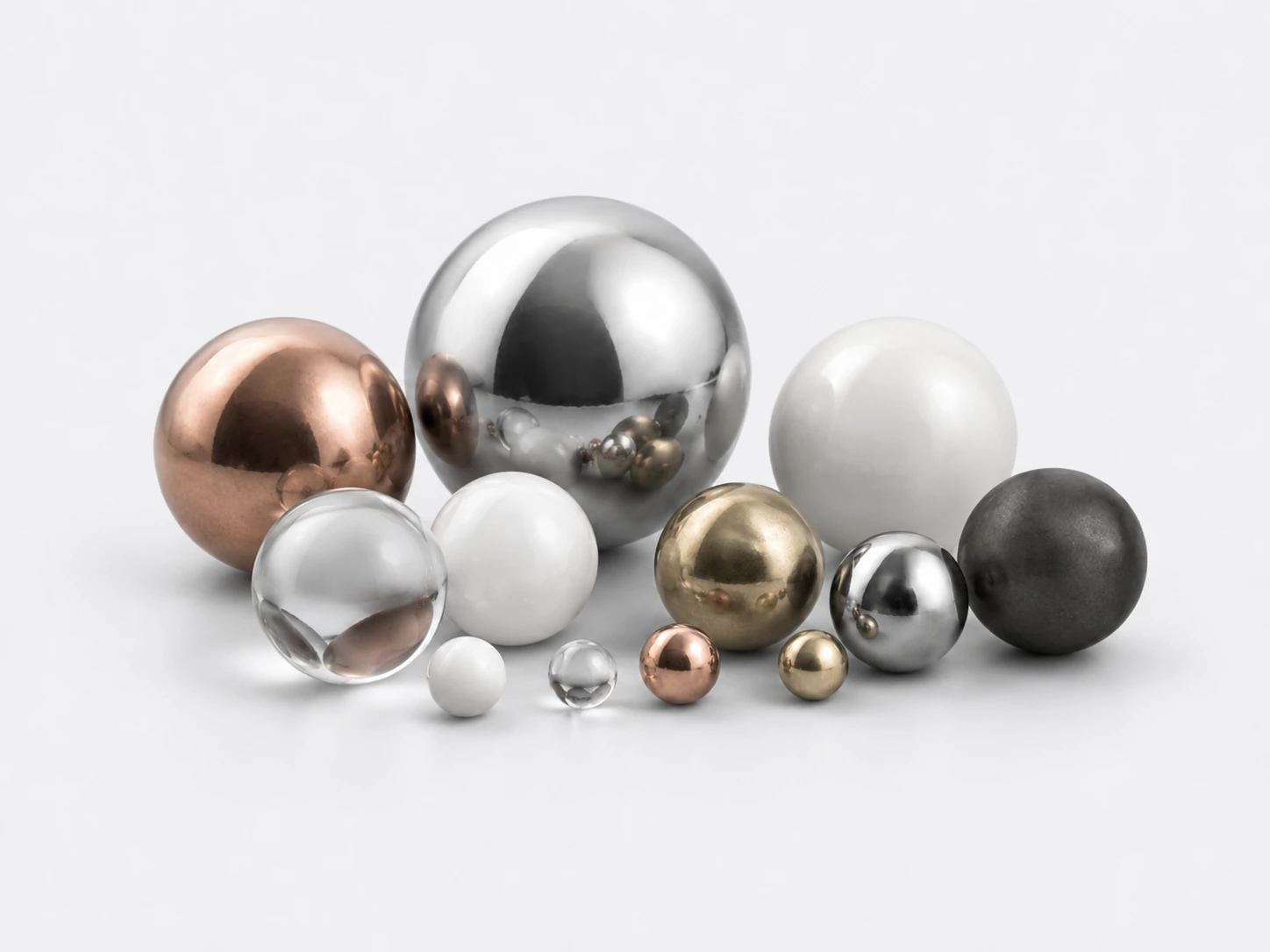
Material selection begins with the work the ball must perform
An industrial ball can act as a rolling element, sealing surface, check mechanism, grinding medium, electrical interface, float or precision component. Those functions expose the ball to very different loads, fluids, temperatures and failure risks. Selecting a familiar material without defining the operating requirement can lead to corrosion, deformation, wear, leakage or unnecessary cost.
A practical selection process starts with the application, then narrows the material family. Diameter, grade, roundness, surface finish and documentation requirements should be specified only after the functional risks are understood.
Ball material comparison at a glance
| Material family | Corrosion resistance | Hardness & wear | Density | Magnetic behavior | Temperature & chemical behavior | Typical applications | Relative cost |
|---|---|---|---|---|---|---|---|
| Carbon steel | Low without protective finish | Moderate to high, depending on grade and heat treatment | High relative to polymers and many ceramics | Magnetic | Limited in wet or chemically aggressive service | Hardware, casters, conveyors, general mechanisms | Low |
| Chrome steel | Limited; not a substitute for stainless steel | High hardness and wear resistance | High | Magnetic | Best in clean, lubricated or protected environments | Bearings, linear motion, pumps, precision mechanisms | Low–medium |
| Stainless steel | Moderate to high; depends strongly on grade and media | Ranges from moderate to high by alloy family | High | Varies by grade and processing condition | Broader environmental capability than bearing steel; verify chemical compatibility | Valves, pumps, food equipment, medical devices, marine assemblies | Medium–high |
| Plastic | Generally high; polymer-specific | Low to moderate; selected for low mass or low friction rather than maximum hardness | Low | Nonmagnetic | Chemical and temperature limits vary widely by resin | Check valves, floats, flow control, packaging, light-duty mechanisms | Low–medium |
| Ceramic | High for many grades | High to very high, with brittle behavior to consider | Low to medium, depending on ceramic | Nonmagnetic | Often suited to temperature, insulation or chemical demands; grade-specific | High-speed bearings, chemical valves, metering, grinding, electrical isolation | High |
| Glass | Moderate to high in compatible media | Moderate hardness; brittle under impact | Medium | Nonmagnetic | Chemical durability and thermal-shock limits depend on glass type | Flow meters, laboratory equipment, valves, mixing and decorative functions | Low–medium |
| Brass & copper | Moderate to high in compatible environments | Low to moderate | High | Generally nonmagnetic | Conductive; compatibility depends on alloy and contacting media | Electrical products, instruments, valves, decorative and conductive assemblies | Medium–high |
| Tungsten & high-density materials | Composition-dependent | High to very high for carbide systems; alloy behavior varies | Very high | Varies by binder and alloy | Must be verified for exact composition and environment | Severe-wear components, high-pressure valves, ballast and specialty mechanisms | Very high |
Relative cost describes a typical sourcing position only. Actual quotations depend on material grade, diameter, precision, quantity, inspection, documentation and packaging.
How the main material families differ
Carbon steel: economical and versatile
Carbon steel balls are commonly selected where cost, strength and magnetic behavior matter more than corrosion resistance. Low- and high-carbon grades can serve different forming, hardness and wear requirements. Protective oil, plating or controlled packaging may be needed for storage and service in humid conditions.
Chrome steel: optimized for hardness and rolling contact
Chrome steel bearing balls, commonly associated with bearing-grade materials such as AISI 52100, are chosen for high hardness, wear resistance and dimensional stability. They perform best where corrosion exposure is controlled. “Chrome steel” describes an alloy family—not a chrome-plated surface—and should not be treated as stainless steel.
Stainless steel: select the grade, not just the family name
Stainless steel balls cover multiple alloy families. Austenitic grades are often selected for corrosion resistance and low magnetic response, while martensitic grades can provide higher hardness and are normally magnetic. The correct grade depends on the fluid, temperature, wear requirement and cleanliness standard.
Plastic: low mass, corrosion resistance and design flexibility
Plastic balls can reduce weight, noise and friction while providing electrical insulation or resistance to selected chemicals. PP, PE, POM, PA, PTFE and other polymers behave differently. The buyer should define fluid exposure, operating temperature, load, dimensional stability and water absorption requirements before selecting a resin.
Ceramic: hardness, low mass and functional performance
Ceramic materials such as silicon nitride, zirconia and alumina offer different combinations of hardness, density, electrical insulation and corrosion resistance. They can be valuable in high-speed bearings, chemical service or severe-wear applications, but brittleness and mounting conditions must be evaluated.
Glass: chemically stable, nonmagnetic and visually inspectable
Glass balls are used in laboratory, fluid-control, mixing and measurement applications. Soda-lime and borosilicate glass do not have identical chemical or thermal behavior. Impact, thermal shock and brittle fracture should be considered before choosing glass for a loaded mechanism.
Brass and copper: conductivity and softer contact behavior
Brass balls and copper balls can support conductive, decorative or softer-contact requirements. Alloy composition affects hardness, color, corrosion behavior and machinability. Confirm the contacting fluid and any restrictions on copper-containing materials.
Tungsten and other high-density materials: use density intentionally
Tungsten carbide balls provide extreme hardness and wear resistance for demanding contact applications, while tungsten alloys may be selected when high density is the primary requirement. These are different material systems. Binder composition, corrosion exposure, impact and cost must be reviewed separately.
A seven-step specification process
- Define the function. Is the ball rolling, sealing, checking flow, transferring load, grinding, floating or adding mass?
- Map the environment. Record fluids, humidity, contaminants, cleaning chemicals and expected temperature range.
- Quantify mechanical demand. Identify static and dynamic load, contact stress, speed, impact and acceptable deformation.
- Set magnetic and electrical requirements. State whether magnetic response, conductivity or insulation is required or prohibited.
- Define geometry and precision. Confirm diameter, tolerance, grade, sphericity, surface finish and any special geometry.
- Define quality evidence. Specify material certificates, inspection reports, traceability, sampling plan and regulatory documents actually needed.
- Confirm commercial conditions. Quantity, samples, packaging, storage protection and delivery cadence can change the practical solution.
What to include in an RFQ
For a faster engineering review, provide as much of the following as possible:
- Ball function and end application
- Preferred material or required performance
- Diameter and dimensional tolerance
- Precision grade, roundness or surface-finish requirement
- Load, speed, temperature and contacting media
- Magnetic or electrical requirements
- Annual and initial order quantity
- Required certificates, reports, packaging and labeling
When the material is not yet fixed, SDBALLS can review the operating conditions and identify practical candidate families for further validation.